Joining forces to promote Green Building
To achieve greater sustainability in construction, the efforts of all stakeholders in this process must be combined. For many types of building products today, the EMICODE® label stands for the lowest possible emissions and thus supports holistic approaches to sustainability on a national and international scale.
The strive for sustainability is also one of the key concerns in the construction sector. However, not every player needs to reinvent the wheel. The GEV, the German Association for the Control of Emissions in Products for Flooring Installation, Adhesives and Building Materials, therefore clearly focuses its sustainability efforts on the assessment and classification of building materials with regard to their emissions, in particular volatile organic compounds (VOCs). By contrast, the leading certification system in Germany, which is that of the DGNB (German Sustainable Building Council), takes a more holistic approach to assessment and certification. This not only considers ecological but also economic and social aspects throughout a building’s entire life cycle.
Thanks to the GEV’s specialization, the EMICODE® and the DGNB complement each other very well in their progress towards more sustainable construction. Two new online brochures, each of them comprising 8 pages, explain the synergies arising from this collaboration. They are available for download from the GEV under the titles “The Role of the EMICODE® in Green Building Certification Systems” and “How DGNB and EMICODE® join forces to promote Green Building”. The DGNB system directly refers to the EMICODE® label as proof of compliance with its VOC emission requirements. These are formulated under DGNB criterion ENV1.2 “Local Environmental Impact” with the goal of avoiding all hazardous or harmful building materials and replacing them with products that promote a healthy indoor climate.
Internationally, too, the EMICODE® label has become an important component of sustainability assessment. Founded in 1990, the BREEAM system is the most successful building certification system worldwide and can boast of more than 600,000 certified projects. It recognizes the EMICODE® as an “approved alternative scheme” that can be used without restriction as proof of compliance with the BREEAM criteria for indoor air quality. In the LEED certification system, developed by the U.S. Green Building Council and backed by expertise from 100,000 certified projects, EMICODE®-certified building products are considered to be “low-emitting materials” that are suitable for meeting LEED emission requirements. However, this “alternative compliance path” is only permitted for projects outside the United States.
The EMICODE® provides scientifically validated proof of emissions
The three systems specify concrete requirements for the components and materials used in the construction of buildings. For the product group “Installation materials and sealants”, all three systems focus on the contribution of these materials to indoor air quality. On the one hand, this involves verifying the emission of volatile organic compounds (VOCs) from individual building materials. On the other hand, the focus is on measuring indoor air quality after completion of the building. By using standardized test methods, the EMICODE® provides objective, transparent and verifiable proof that a product has a low content of harmful pollutants. The emission tests are carried out in test chambers by independent, accredited testing institutes. Other sustainability criteria, such as the global warming potential (GWP), are given little or no weight in building certifications when it comes to installation materials, as these products account for only a very small portion of the total building.
While “sustainability” has meanwhile become a buzzword, the term is not always clearly defined. In the well-established “three-pillar model”, the term encompasses not only environmental but also economic and social aspects. This makes sustainability a challenging and complex topic. The most important ecological goals are conserving natural resources, avoiding pollutants and hazardous substances (especially indoors), reducing the carbon footprint, and protecting biodiversity. Economically, the primary goal is to design buildings in a way that enables their long-term, energy-efficient and flexible use. The social goal is to safeguard the health and well-being of both construction workers and craftsmen and of the buildings’ future residents – regardless of whether the spaces are meant for work or residential use. This includes, for instance, good indoor air quality and effective heat protection.
Conclusion: Through the collaboration of the EMICODE® with holistic building certification systems such as the DGNB’s, the GEV makes an important contribution to greater sustainability in construction. Being a sophisticated, reliable and recognized certification system for building products, the EMICODE® facilitates the work of architects, planners and contractors when selecting products and providing documentation for buildings seeking LEED, BREEAM or DGNB certification. While the DGNB handles the strategic and holistic assessment of sustainability and indoor air quality, the EMICODE® supplies the specific tools needed to provide measurable proof of the low-emission quality of building products.
The two new brochures on these topics can be downloaded free of charge from the GEV:
https://www.emicode.com/wp-content/uploads/2026/05/Broschuere-DGNB-EMICODE-DE.pdf
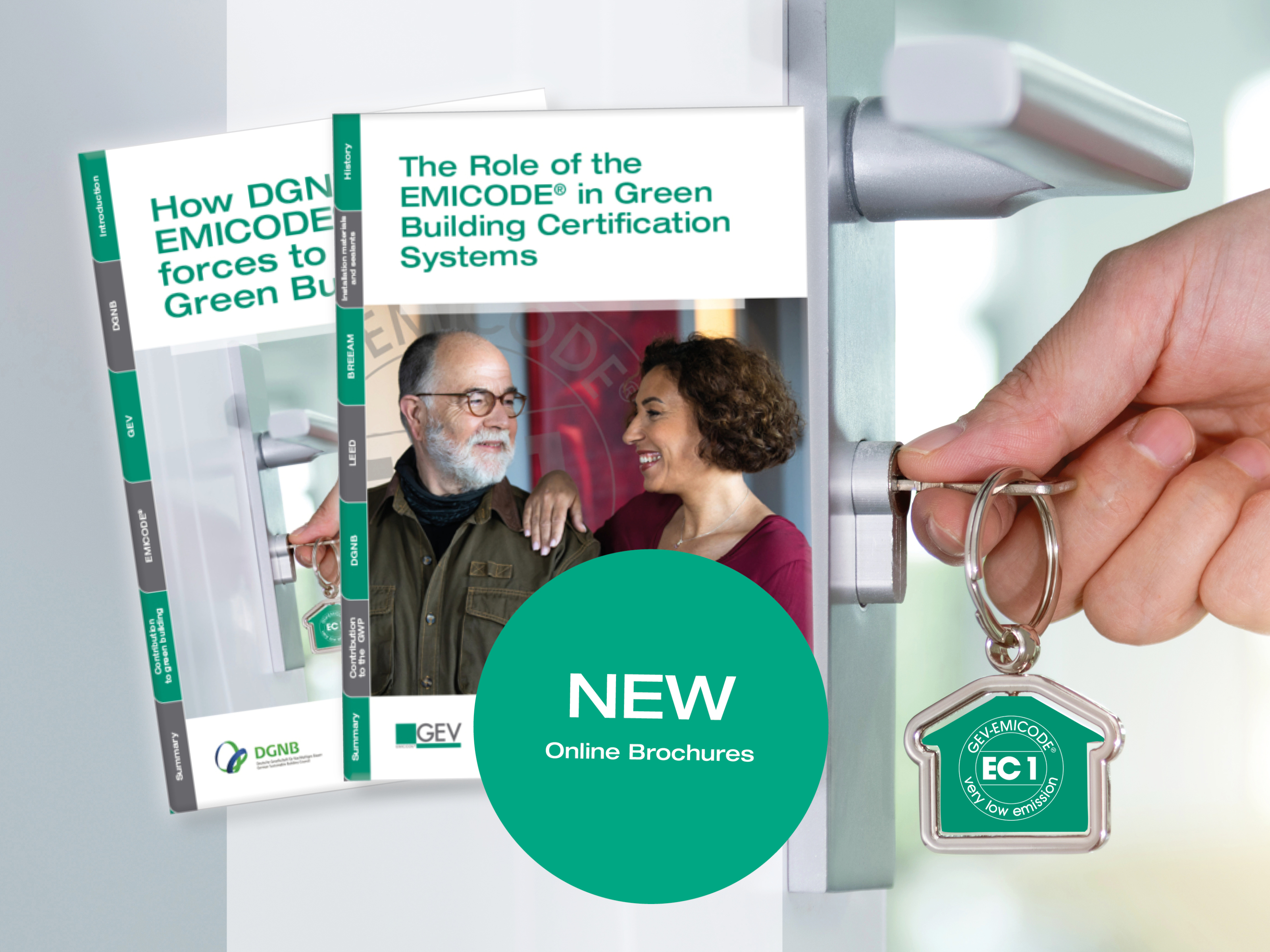
Photo: GEV
The brochure “How DGNB and EMICODE® join forces to promote Green Building” (left) explains how the DGNB handles the strategic and holistic assessment of sustainability and indoor air quality, while the EMICODE® focuses on providing measurable proof that building products are free of harmful substances.
The brochure “The Role of the EMICODE® in Green Building Certification Systems” (right) describes the impact of the EMICODE® in the context of national and international building certification systems. It also demonstrates how this reliable and recognized certification system facilitates the work of architects, planners and contractors in selecting products and providing documentation.
Do You Have Questions?
If you have any questions on certain topics or want to contact us for another reason,
please contact us by phone or email.
Phone: +49 (0)211 843 449 – 01
info@emicode.com
Share article on Social Media: