How to recognize trustworthy eco-labels
Given today’s multitude of eco-labels and quality seals, how can we ensure genuine transparency for planners, building contractors and consumers? Our expert explains what you need to bear in mind when separating the wheat from the chaff of available certifications.
In November last year, the GEV, which is the German Association for the Control of Emissions in Products for Flooring Installation, Adhesives and Building Materials, successfully presented itself at the “Heinze Klimafestival für die Bauwende” in Berlin (climate festival concerning the turnaround in the building sector). The event focused on the question of how architects can reliably filter out trustworthy eco-labels from the multitude of available labels and seals. Several key points emerged during the discussion.
Tip 1: Beware of greenwashing!
These days, many eco-labels and seals claim to stand for quality, environmental compatibility and safety for human health. But upon closer inspection, some of them lack the necessary scientific rigor when it comes to product testing. Some labels or seals are exclusively based on voluntary self-regulation, and their evaluation criteria are sometimes too ambiguous or even outdated. Moreover, manufacturers often use eco-labels as a marketing tool without implementing genuine ecological innovations. Through “greenwashing” their products, they try to gain a competitive advantage in the market.
Tip 2: Pay attention to scientific rigor in product testing
Since its inception, the GEV has placed great emphasis on utmost reliability and trust-worthiness in product testing. Independent laboratories subject the building chemical products to a rigorous test regime to determine their emission behavior. But that’s not all: Even after a product has been licensed with the EMICODE® label, the GEV commissions test institutes to carry out unannounced spot checks. In this way, the EMICODE® provides all parties involved in the construction process with reliable guidance concerning the emission behavior and thus also facilitates the choice of suitable products.
Tip 3: How strong is the network of the organization that awards the label?
A label can be created and affixed in no time. But which organization, which testing procedures, and which networks form the basis for a label? Meanwhile, the GEV counts about 270 companies from 24 countries among its members. They all meet the strict requirements of the EMICODE® label. Currently, a total of 17,339 products across nine product categories – ranging from flooring installation to wall building materials – has been EMICODE®-certified
Tip 4: Reputable providers complement each another
Since no single label can cover every aspect of healthy living and sustainability, a certain amount of labor division among the certification bodies makes sense. The GEV does not intend to develop the EMICODE® into a universal, all-inclusive sustainability label, but rather focuses on statements concerning the emission of pollutants such as volatile organic compounds (VOCs) into indoor air. In addition, the GEV is seeking collaboration with established organizations such as the German Sustainable Building Council (DGNB) in order to achieve the interlocking of different systems. The application procedure is being simplified for all parties involved. In an unbureaucratic way, the EMICODE® label can become part of the certification process for sustainable buildings. The use of EMICODE®-certified products ensures indoor air quality that is largely free of harmful pollutants. It thus enables architects and planners to submit a promising application to building certification systems such as DGNB, LEED, BREEAM or QNG. The low VOC emissions of building products bearing the EC1 label protect both contractors and consumers from unpleasant surprises when later measuring the indoor air quality.
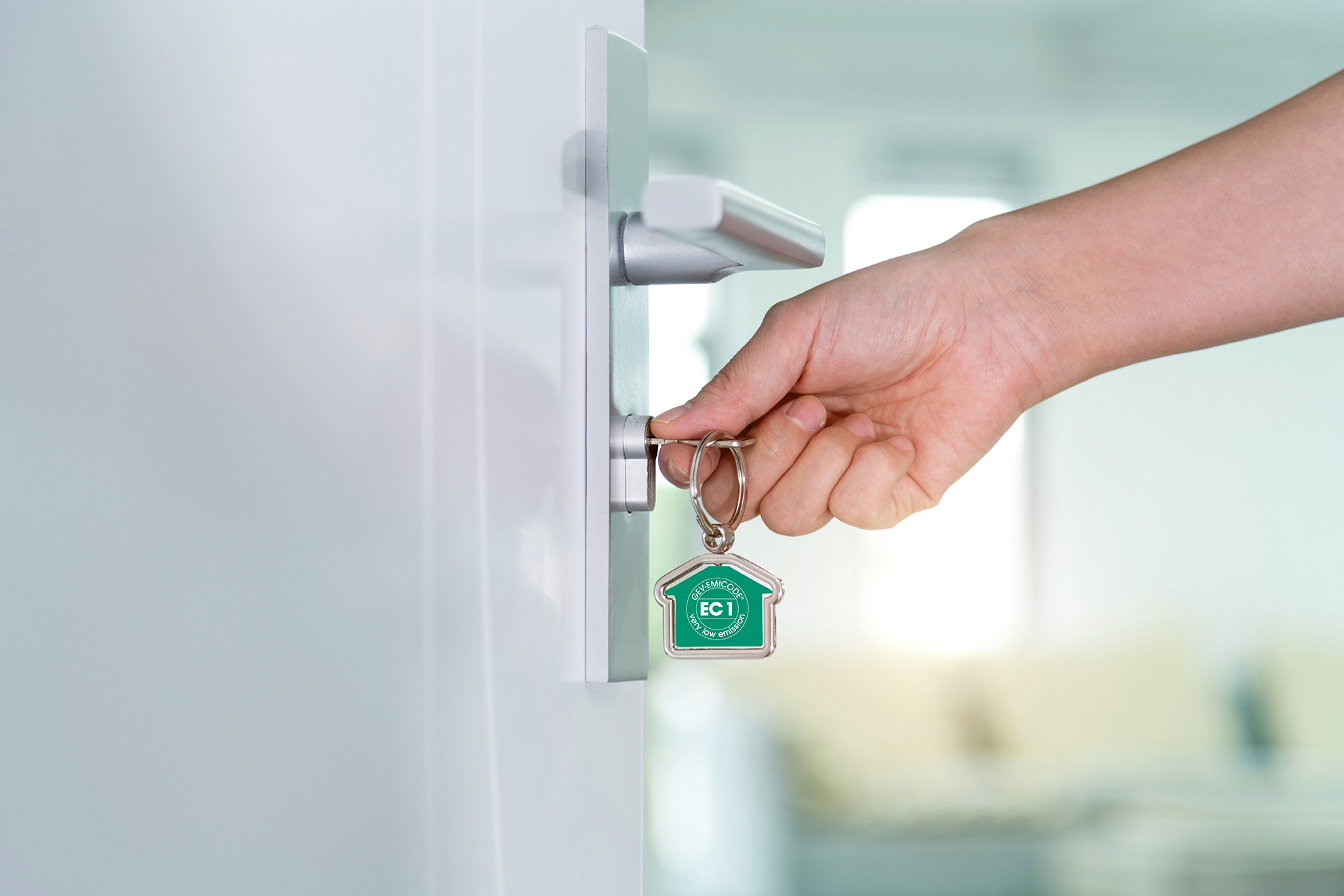
Photo: © GEV/Iris Pohl
Share article on Social Media: