How to make your old floors shine again
When it begins to show that the old floor coverings have seen better days, many home-owners consider a renovation. However, throughout the entire renovation process, it is important to choose exclusively products that feature very low levels of harmful emissions – no matter whether you make use of primers, adhesives, oils or varnishes. This is what the EMICODE® label guarantees: lowest possible emissions and healthy indoor air.
They get trampled on, maltreated by vacuum cleaners and bobby cars, objects of daily life falling down and leaving damage: floors take a real beating over the course of their lifetime. Regardless of the type of flooring – whether wood, tile, vinyl, or other materials – eventually it’s time for a refresh or renovation. It’s not always necessary to rip out the existing flooring. With a tiled floor, for instance, it is often sufficient to simply replace those tiles that have cracks or chipped corners. Homeowners usually have a few spare tiles from the current flooring stored in the basement or garage. After replacing the defective tiles, the entire floor can be regrouted. Even if there are no damaged tiles, regrouting the floor can make a huge difference.
Other types of flooring can also be renovated at reasonable effort and expense. Concrete, for example. After sanding, it can be covered with any type of flooring – whether wood, ceramic, natural stone, or other materials. Alternatively, the sanded concrete surface can be finished as exposed concrete. In both cases, it is important to note that concrete has an open-pored surface after sanding, which must be treated by oiling, waxing or sealing after vacuuming off the sanding dust.
Cement screeds can be renovated in a similar way. Any unevenness that may have been caused when removing the old flooring can be repaired with a leveling compound. Once the screed has dried and, if necessary, been sanded, the floor is ready for the installation of a new covering. In utility and cellar rooms, it is also possible to simply seal the screed and use it without any covering.
If old textile flooring has been glued to the subfloor, removal can be challenging. If a water-soluble adhesive was used, the carpeting can be pulled off relatively easily after moistening it for approx. 1 to 2 hours. With a non-water-soluble adhesive, more effort is required. Once the old carpeting has been removed, some adhesive residue may remain on the floor. This can be treated with hot air (hairdryer) or soapy water so that afterwards it can be scraped off with a putty knife. If none of this works, special chemical agents must be employed. Finally, depending on its condition, the subfloor can be sanded and prepared for the new flooring.
Design or vinyl flooring can also be refinished. All you need to do is lightly roughen the surface, re-seal it, and then apply a special protective coating. After that, the flooring will shine like new again.
Floors made of wooden floorboards or parquet can be refinished multiple times, giving them an extremely long service life (with proper care, solid wood parquet can last 60 to 100 years) and making them particularly sustainable. Over the years, wood flooring can be sanded down several times and then newly oiled, waxed or sealed. This particular sustainability is only achieved if the parquet floor is firmly glued to the subfloor. It is not advisable to carry out a floating installation of parquet, which is often done by homeowners themselves. The reasons: Glued-down parquet is much more stable, can withstand heavier loads, and can be sanded down more easily.
No matter what type of floor renovation is planned, whether you are a professional floorer or a do-it-yourselfer: You should always wear protective gear such as a fine-dust mask and work gloves when removing old flooring. And when refinishing the old or installing the new flooring, only materials should be used that are not harmful to human health. Healthy living spaces are created when low-emission products bearing the EMICODE® seal are used. The GEV, which is the German Association for the Control of Emissions in Products for Flooring Installation, Adhesives and Building Materials, awards the EMICODE® label only to products whose safety for human health has been verified through rigorous laboratory testing. Manufacturers must subject their products to regular unannounced spot checks carried out by independent test institutes. They are only allowed to advertise their products with the EMICODE® seal if this is renewed after 5 years at the latest. EMICODE®-certified products contain neither solvents nor phthalate-based plasticizers and are free of harmful VOCs (volatile organic compounds).
There is a wide range of products that are eligible to bear the EMICODE® label. Whether primers, adhesives, screed mortars, grouts, sealants, or surface treatments for hardwood floors such as oils and varnishes: Consumers and contractors alike can use the EMICODE® seal as a guide for product selection in order to ensure a healthy living environment with good quality indoor air after completion of flooring works.
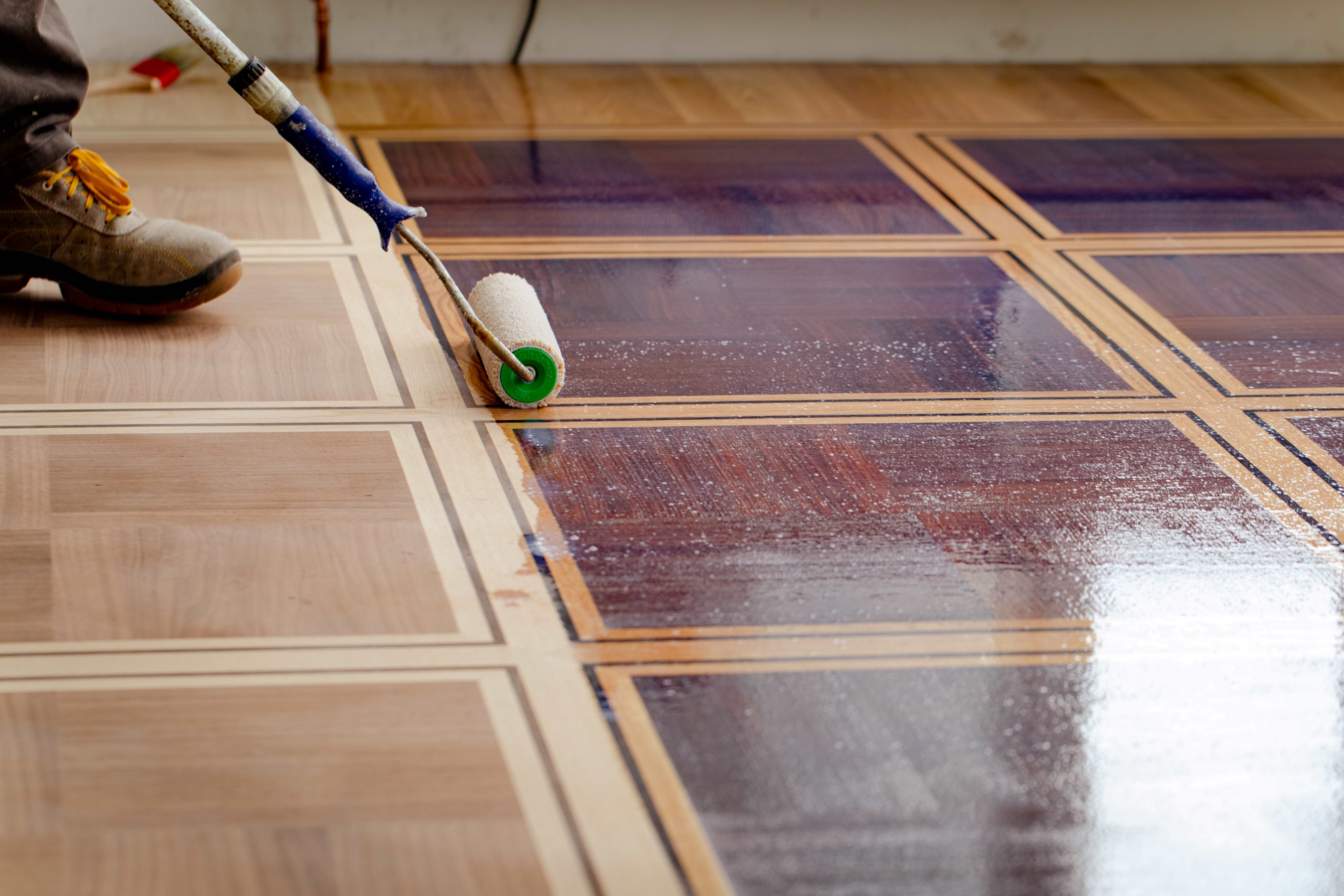
Photo: © Iris Pohl/GEV
Parquet flooring that has been firmly glued to the subfloor can be sanded down and refinished several times. After sanding, remove the dust and seal the floor.
Do You Have Questions?
If you have any questions on certain topics or want to contact us for another reason,
please contact us by phone or email.
Phone: +49 (0)211 843 449 – 01
info@emicode.com
Share article on Social Media: